Russian for beginners
Russian for beginners is an introduction to the Russian language.
Russian letters
This page will help you to learn the Russian letters.
If you decided to learn the Russian language I would advise you to learn the Russian alphabet first. There are 33 letters in the Russian alphabet 10 of them are vowels, 21 consonants and 2 signs, which have no sounds (ь, ъ). Try to use different strategies to memorize the letters. The easiest one probably to learn the words starting with the particular letter. I’ll give you a few examples. You can also compare pronunciation of the Russian and English letters, some of them you will find quite similar. Even though the rest of them may sound differently you will get an idea of the Russian letters and also it will be easier for you to remember them if you will associate the Russian letters with the English words. It’s not easy to pronounce some of the Russian letters if you are a native English speaker, especially the letter Р (R), but if you will practise you will manage it. Nothing is impossible.
The Russian alphabet

Аа Бб Вв Гг
Дд
Ее
Ёё Жж Зз Ии
Йй Кк Лл Мм
Нн Оо Пп
Тт Уу Фф Хх
Цц Чч Шш Щщ
Ьь Ыы Ъъ Ээ
Юю Яя
- А а рбуз – u nder
- Б б окс – b alloon
- В в агон – v an
- Г г ород – g lasses
- Д д руг – d og
- Е е рунда – ye t
- Ё ё жик – g i rl
- Ж ж ираф – ca s ual
- З з елёный – z ip
- И и гла – i ll
- Й й огурт – bo y
- К к от – c at
- Л л ампа – l ong
- М м а м а – m u m
- Н н ога – n oise
- О о н – o ver
- П п арк – p en
- Р р ека – r eason
- С с олнце – s un
- Т т ам – t all
- У у тюг – gl u e
- Ф ф лаг – le f t
- Х х омяк – h orse
- Ц ц ентр – le ts
- Ч ч удо – ch ild
- Ш ш кола – sh opping
- Щ щука – sh and ch together
- Ь no sound
- Ы д ы м – charit a ble
- Ъ no sound
- Э э кскаватор – e nd
- Ю ю г – u niversity
- Я я ма – you ng
Russian letters – pronunciation
Vocabulary
- алфавит – alphabet
- буква – letter
- русский – Russian
- звук – sound
- а рбуз – watermelon
- б окс – box
- в агон – carriage
- г ород – city
- д руг – friend
- е рунда – nonsense
- ё жик – hedgehog
- ж ираф – giraffe
- з елёный – green
- и гла – needle
- й огурт – yogurt
- к от – c at
- л ампа – lamp
- м а м а – m u m
- н ога – leg
- о н – he
- п арк – park
- р ека – river
- рыба – fish
- рана – wound
- с олнце – s un
- т ам – there
- утюг – iron
- ф лаг – flag
- х омяк – hamster
- ц ентр – center
- ч удо – miracle
- ш кола – school
- щука – pike
- д ы м – smoke
- э кскаватор – excavator
- ю г – south
- я ма – pit
Vowels
Consonants
б в г д ж з й к л м н п р с т ф х ц ч ш щ
If you want to memorize the Russian alphabet please follow the
link, where you will find revision cards, exercises and tests
which will help you to remember the Russian letters and to learn
how to pronounce them –
Interactive Russian alphabet
.
About Russian for beginners
Russian Sounds
Russian sounds – vowels
Even though there are 10 letters in the Russian alphabet which represents vowels, there are just 6 main vowels in the Russian language: [a], [o], [у], [ и ], [э], [ы]
Stressed and unstressed
Vowels may be stressed or unstressed. The same as the English words, the Russian words may change their meanings if you emphasize the wrong syllable. For example recórd – rėcord. In the Russian language you will find many such cases.
Number of sounds
Also we can split the Russian vowels according to the number of
the sounds they represent.
Russian vowels (letters) may be the representatives of one (
дом
– д[
о
]м) or two (яма –
[й’а]ма) sounds.
Letters ё, ю, я , е denote two sounds:
- if they are at the beginning of the word (юг – [й’у]г)
- if the are after a vowel ( нова [й’a], летня[й’а]
- if they are after signs ъ, ь (подъ[й’э]зд), after ь letter и also denotes two sounds – соловьи соловь[й’ и ] (plural of соловей)
Russian sounds – consonants
The pronunciation of the Russian consonants depends on the level of the closure of the vocal tract. As a learner you may want to know two basic classification of the Russian consonants.
- According to the degree we use our voice pronouncing the Russian consonants we can split them into two groups – sonorants and obstruents. Obstruents consonants may be voiced or voiceless.
- According to the way we pronounce the Russian consonants (we move the middle of the tongue up, against the top of the mouth or not) we differ soft and hard consonants.
Also the consonants differ according to the time we pronounce the Russian sounds. The sound is long when:
- two same letters next to each other (гру пп а, ма сс а)
- two different letters next to each other (бе сш умно)
- щ – conveys the long soft voiceless hushing sound (щука)
Voiced and voiceless consonants

Hard and soft consonants
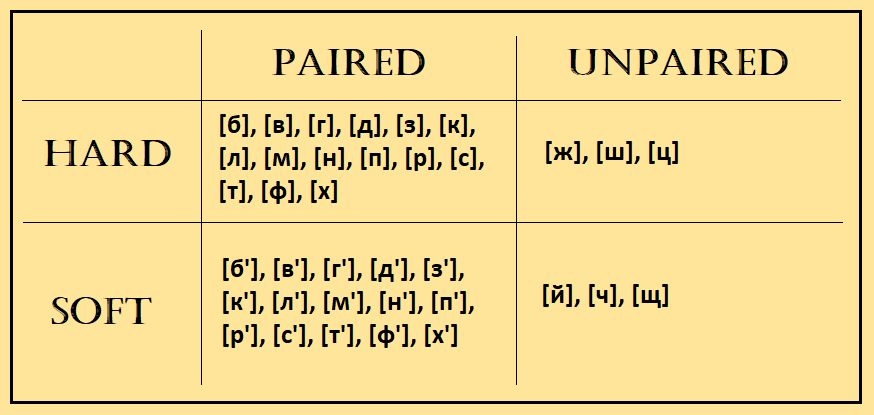
To show the hardness or the softness of the Russian consonants in writing we use the vowels and the soft sign.
- If there are letters а, о , у, ы, э after the consonants it means that the consonants are hard (мост, так, лук, сыр, мэр).
- If there are letters я , ю, е, ё, и after the consonants it means that the consonants are soft (мяч, люк, лес, клён, тир).
- The same rule works for the soft sign, so if there the soft sign after the consonant it means that the consonant is soft (соль, лень).
An exception of this rule are unpaired by their softness or hardness consonants.
- Sounds [ж], [ш], [ц] are always hard, despite the existence of the letters я , ю, и , е, ё or the soft sign behind them.
- Sounds [ш’], [ч’], [й’] are always soft , despite the existence of the letters а, о , у, ы, э behind them
These rules often don’t work for the foreign words.
Soft consonant [й]
To get The Russian sound [й] employ:
- letter й (йогурт)
- letters ё, я , е, ю
at the beginning of the word (ёжик –
[й’
о
]жик)
after vowels (живая –
жив
а
[й’а]
after soft sign ь (ружьё
– ружь[й’
о
]
after hard sign ъ объём
– объ[й’
о
]м
Vocabulary
If you just have started to learn Russian before to move any further learn the Russian alphabet first .